
Retaining Walls in San Antonio & the Texas Hill Country
Native limestone rock walls, cut stone walls and engineered block - built to hold ground that does not want to be held.
Native Limestone Rock walls, Retaining Walls & Cut Stone Walls
A retaining wall is the one piece of landscape work that has a job to do. It is holding soil, and behind it water is looking for a way out. Built properly it will outlast the house. Built badly it leans within a few seasons, and the repair costs more than the original wall.
We have been building walls across the Hill Country since 2016, and the masonry crew is ours - not a subcontractor we call when a job comes in. So is the equipment, which on this kind of work decides what is possible. Keying a footing into limestone shelf is a machine problem before it is a craftsmanship problem.

What we build
Native limestone rock walls
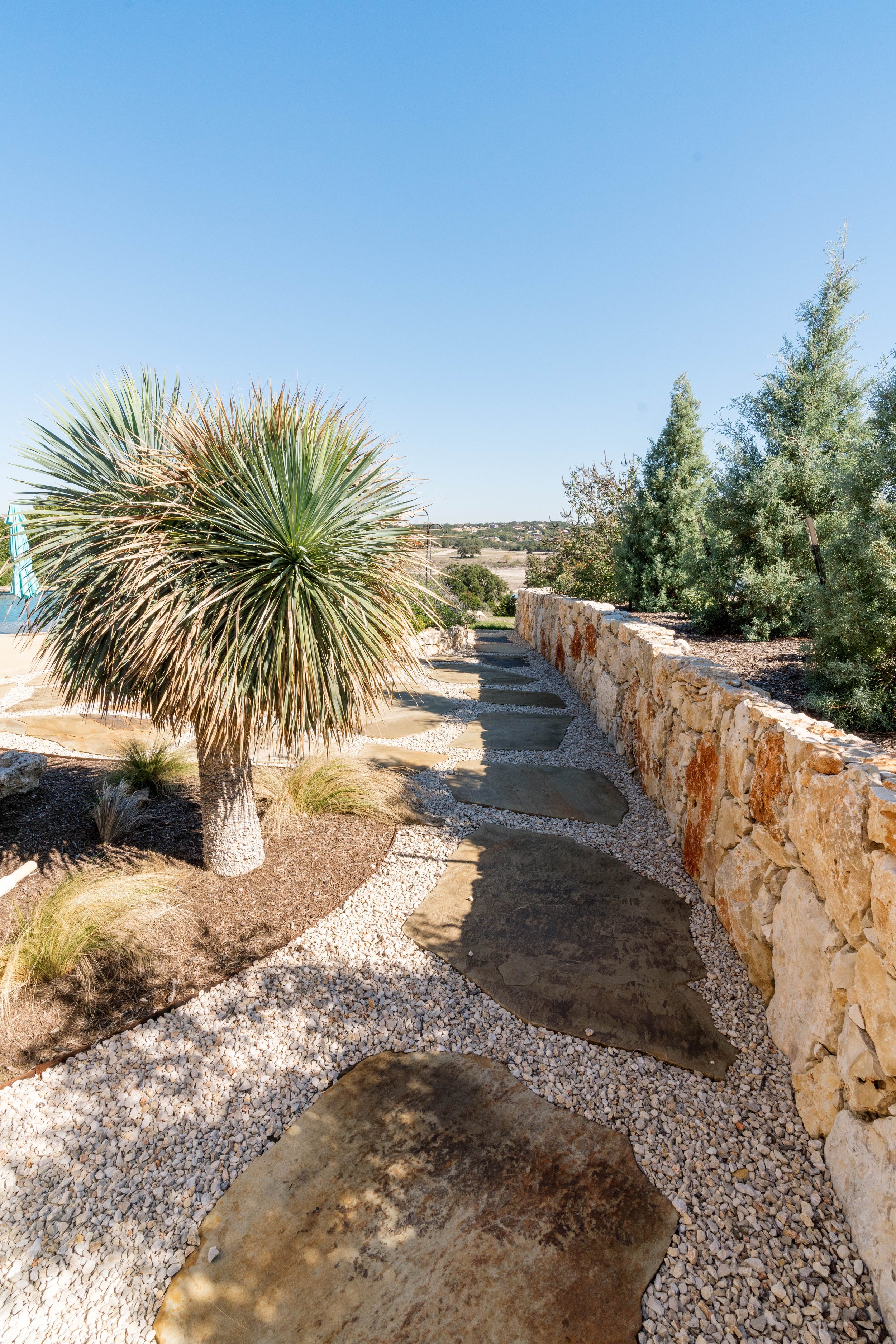
Dry-stacked local stone, laid by hand. The most at-home look in the Hill Country, and the most forgiving of ground movement because the wall can breathe and shift fractionally without cracking. Best for garden terraces, seat-height walls and anywhere the wall is as much a feature as a function.
Cut stone walls
Squared and coursed stone, mortared, with a finished face. Crisper and more formal than dry-stack, and the right answer when the wall is doing architectural work next to the house rather than sitting out in the landscape.
Segmental block walls
Engineered modular block with geogrid reinforcement where height and load call for it. Less expensive per foot than stone and the strongest option for taller walls, with a stone or veneer face if you want the look without the cost.
Boulder and rip-rap walls
Large native boulders set with machinery. Fast, heavy and permanent, and well suited to the back of a property, a creek bank or a long slope where the scale suits the stone.
Terracing and multi-tier walls
Two or more shorter walls stepped up a slope instead of one tall one. Often cheaper, almost always better looking, and it turns an unusable grade into two or three flat, usable levels.
Why walls fail and what we do instead
Almost every failed retaining wall in this part of Texas fails for the same three reasons, and none of them are the stone.
No drainage behind the wall. Soil holds water, water is heavy, and the pressure has nowhere to go but through the wall. We build in gravel backfill and drain pipe as standard, not as an upgrade.
No proper base. A wall set on soil instead of a compacted base moves as the ground moves. Ours go on a prepared base, keyed into rock where the rock is there to key into.
Wrong wall for the height. A dry-stack garden wall and a four-foot structural wall are different builds. Putting the first where the second belongs is the most common and most expensive mistake we get called out to fix.
If your wall is tall enough to need engineering, we will tell you at the consultation rather than after it is built.
Built for Hill Country ground
Most properties here sit on limestone with thin soil over caliche. That changes the whole calculation: how deep a base can realistically go, where a footing can key into rock instead of sitting on fill, and where water will travel once you have put a solid wall in its path.
It is also why slope is so common on local lots, and why terracing so often beats one tall wall. Hill Country ground sheds water rather than absorbing it, so a wall here is as much a drainage decision as a structural one.
Common questions about Native Limestone Rock Walls, Retaining Walls & Cut Stone Walls
-
Neither is better outright. Dry-stacked native limestone moves with the ground and drains through itself, which suits garden terraces and seat walls. Mortared cut stone gives a crisper, more formal face and suits walls working against the house. The height, the load and where the wall sits decide it, and we will tell you which on site.
-
Taller than most people expect — but height changes the build. Low garden walls are straightforward. Past a certain height a wall becomes a structural element needing reinforcement, engineered drainage, and in some jurisdictions an engineer’s design and a permit. We will tell you which category yours falls into before anyone quotes you.
-
Yes, and most of our walls are one or both. Rock is an equipment question rather than an obstacle — and a footing keyed into limestone is a better foundation than anything you could build in soil. We own our machinery, so we take these sites on instead of designing around them.
-
Always. Gravel backfill and drain pipe behind the wall are part of how we build, not an add-on. Water pressure is what knocks walls over, and a wall quoted without drainage is a wall quoted to fail.
-
Usually. We will come out and tell you honestly whether it is a repair, a partial rebuild or a full replacement and what caused it, because a wall rebuilt without fixing the drainage will go the same way again.
-
Yes. Walls, hardscape, planting, irrigation and outdoor structures are all our own crews, so the wall and everything around it get sequenced properly instead of coordinated between two companies.
Ready to talk about your wall?
Call (210) 446-9202 or send us the details and we will come out and walk the slope with you.